
Guide · Appraisals
UAD 3.6: the new home appraisal report, explained.
UAD 3.6 is the new standard for home appraisals on conventional mortgages. Starting November 2, 2026, every new appraisal submitted to Fannie Mae or Freddie Mac must use the redesigned Uniform Residential Appraisal Report (URAR): one report that replaces the old appraisal forms, puts the value, the home's condition and any required repairs on page one, and breaks square footage out into clearly labeled figures. How a home is valued does not change. The report just looks different and carries more detail.
- Nov 22026 mandatory date for conventional loans sold to Fannie Mae and Freddie Mac
- 14 → 3legacy appraisal form types consolidated into three reports
- Page 1value, condition rating and required repairs, up front
- Sq ftabove-grade, below-grade and unfinished area each listed separately
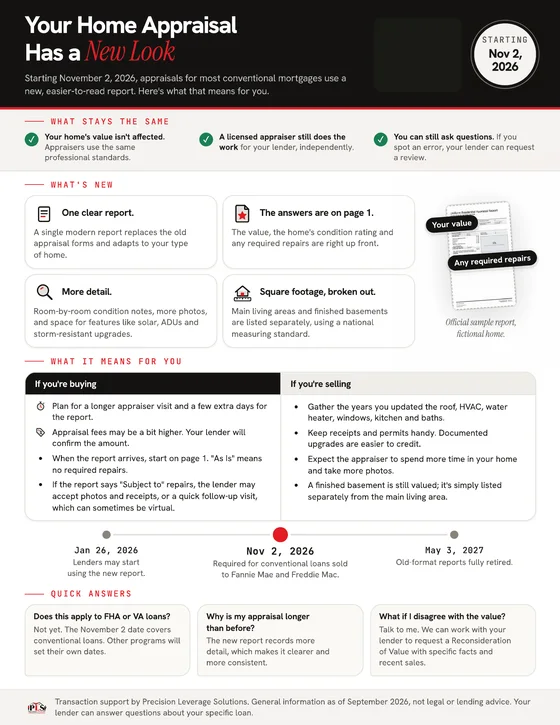
Free download for agents
Your Home Appraisal Has a New Look.
A one-page, plain-language guide you can hand to buyers and sellers before the appraisal. It covers what stays the same, what is new, what to expect as a buyer or a seller, the key dates, and the three questions clients ask most. Print it, attach it to your under-contract email, or drop it in the transaction file.
- Letter size, prints cleanly in black and white
- Written for consumers, no appraisal jargon
- Free to share with your clients
Everything in the PDF is also written out on this page, for screen readers and for anyone who would rather read it here.
What is UAD 3.6?
UAD stands for Uniform Appraisal Dataset. It is the rulebook Fannie Mae and Freddie Mac (the two government-sponsored enterprises that buy most conventional mortgages) use to define what goes into a home appraisal and how each item is reported. The “3.6” refers to version 3.6 of the MISMO Reference Model, the mortgage industry data standard that the new dataset is built on.
The practical change is the report itself. For years, appraisers picked from a family of fixed forms: one for a single-family home, another for a condo, another for a two-to-four unit property, another for an exterior-only appraisal, and so on. UAD 3.6 replaces that family with one dynamic report, the redesigned Uniform Residential Appraisal Report (URAR), which adds or removes sections based on the property and the assignment. Two companion reports cover follow-up work: a Completion Report and a Restricted Appraisal Update Report.
Retired legacy forms
- 1004 / 70
- 1004 Desktop
- 1004 Hybrid
- 1073 / 465
- 1073 Desktop
- 1073 Hybrid
- 1075 / 466
- 2055
- 1004C / 70B
- 2090
- 2095
- 1025 / 72
- 1007 / 1000
- 1004D / 442
UAD 3.6 reports
The UAD 3.6 timeline
The rollout has been running in stages since 2025. The date that matters for most transactions is November 2, 2026.
- Sep 8, 2025Limited production. A small group of lenders and appraisers begin testing the new report on live loans.
- Jan 26, 2026Broad production. Any lender can use the new report. Old and new formats are both accepted.
- Nov 2, 2026Mandatory. New appraisals submitted to the GSEs’ appraisal portal must use UAD 3.6.
- May 3, 2027Legacy retired. Revisions to old-format reports are accepted through this date, then end.
Contracts written in late October and November are the ones to watch. An old-format appraisal completed in October but not submitted by the lender until November 2 or later will be rejected and has to be redone in the new format. Appraisers are also still getting used to new software. Build a little extra time into appraisal and financing dates.
What stays the same
How your home is valued. Appraisers follow the same professional standards (USPAP) and the same valuation approaches. A new form does not raise or lower a value.
Who does the work. A licensed or certified appraiser still inspects the home and reports to the lender, independently of the buyer, seller and agents.
Your right to ask questions. If you spot an error or have better comparable sales, you can still ask the lender for a review, called a Reconsideration of Value.
What is new in the report
One clear report
A single modern report replaces the old forms and adapts to the type of home, so a condo report and a single-family report share one layout.
The answers are on page 1
The opinion of value, whether it is “As Is” or “Subject To” repairs, the overall condition and quality ratings, and any defects that need action are summarized up front.
More detail, more photos
More structured detail about the kitchen, bathrooms and other areas, when they were updated, and more photographs. Features like solar panels (owned or leased), accessory dwelling units, energy-efficient upgrades and disaster-mitigation features have dedicated places in the report.
Square footage, broken out
Finished above-grade, finished below-grade, nonstandard finished and unfinished area each appear as their own figure, measured under the ANSI Z765-2021 standard, so it is easy to see what makes up the total.
How to read page 1 of the new appraisal
If a client reads only one page, make it this one. The summary page pulls the answers most buyers, sellers and agents care about into a single view. Here is the official Fannie Mae and Freddie Mac sample (a fictional home) with the parts that matter marked.
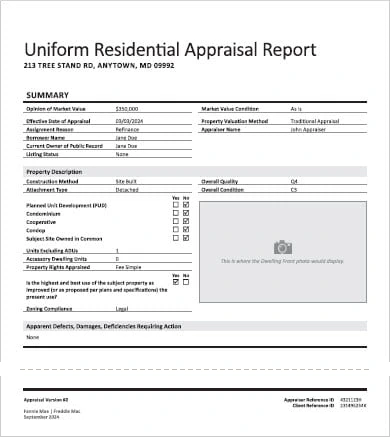
- Opinion of Market Value. The appraised value, and the effective date it applies to.
- Market Value Condition. “As Is” means the value does not depend on repairs. “Subject To” (repair, inspection or completion) means the value depends on something being done or checked first.
- Overall Quality and Condition. The Q1 to Q6 and C1 to C6 ratings, explained below.
- Property Description. Construction method (site built, manufactured and so on), attachment type, condo or PUD status, number of units, and any accessory dwelling units.
- Apparent Defects, Damages, Deficiencies Requiring Action. Anything the appraiser says must be addressed. “None” is the answer everyone wants.
Square footage and finished basements
This is the part most likely to surprise a seller, even though the rules themselves are not new. Appraisers have measured to the ANSI Z765-2021 standard on most Fannie Mae and Freddie Mac appraisals since April 2022, and gross living area has always counted only above-grade space. The new report makes the breakdown far more visible: finished area above grade, finished area below grade, nonstandard finished area and unfinished area are each listed as their own figure. A finished basement is still described, measured and valued; it is simply not part of the main living area number.
The ceiling-height rule
ANSI Z765 also sets a minimum ceiling height for space to count as finished area. In general, a finished space needs a ceiling of at least 7 feet. Under a sloped ceiling, such as a finished attic room or a cape cod upstairs, at least half of the space must be 7 feet or higher, and any part under 5 feet is not counted. Final square footage is reported to the nearest whole square foot. Finished space that falls short of these rules is reported separately as nonstandard finished area, and it can still add value. Condo and co-op apartment units are measured differently, using interior walls.
Why this matters to sellers: the square footage in the MLS listing, the tax record and the appraisal can all be different numbers, measured different ways. If the listing advertises “2,600 square feet” including a finished basement, the appraisal may show 1,900 above grade plus 700 below grade. The house is the same. Set that expectation before the appraisal, not after.
Condition and quality ratings, in plain language
The familiar six-step scales carry over into UAD 3.6 with rewritten, clearer definitions, and the report now adds separate interior and exterior ratings alongside the overall ones. Lower numbers are better. Most well-kept homes land in the middle.
A C6 rating means the home must be repaired to at least C5 before a Fannie Mae or Freddie Mac loan can close. A C5 home can often be financed as is, but anything that affects safety, soundness or structural integrity has to be fixed first, and those items make the appraisal “Subject To” repairs. That is where the next section comes in.
“As Is” vs “Subject To”: what happens next
The value is for the home in its current condition and does not depend on repairs. The report can still note minor wear; the lender makes the final call.
Repairs, completion or an inspection come first.
- Repair or complete the listed items.
- The lender verifies the work. Depending on the item and the lender, that can be a signed borrower letter with photos and paid invoices, a report from a qualified professional, or an appraiser’s Completion Report after an in-person or virtual inspection.
- The loan continues once the lender clears the condition.
What UAD 3.6 means for buyers and sellers
If you are buying
- Plan for a longer appraiser visit and possibly a few extra days for the report while appraisers adjust.
- Appraisal fees may be a little higher in some markets. Your lender will confirm the amount.
- When the report arrives, start on page 1. “As Is” means the value does not depend on any repairs.
- If it says “Subject To,” ask your lender how the condition will be cleared and how long it takes.
- You are entitled to a copy of the appraisal from your lender, promptly after it is completed or three business days before closing, whichever comes first.
If you are selling
- Gather the years you updated the roof, HVAC, water heater, windows, kitchen and baths.
- Keep receipts and permits handy. Documented upgrades are easier for an appraiser to credit.
- If you have solar, know whether the panels are owned or leased, and have the paperwork ready.
- Expect the appraiser to spend more time in the home and take more photos.
- A finished basement is still valued. It is simply listed separately from the main living area.
What agents should change now
Most of this is small adjustments to habits you already have. Here is the short list we are working from with our own clients.
- Re-check appraisal and financing dates on contracts written for late October and November. Any old-format appraisal not submitted by the lender before November 2 must be redone in the new format, and turn times are likely to stretch while appraisers learn the new software. A few extra days in the contingency is cheap insurance.
- Collect the seller’s upgrade list at listing. Years and receipts for roof, HVAC, water heater, windows, kitchen and baths. Hand it to the appraiser at the appointment.
- Talk about square footage early. If the listing number includes a basement, explain now that the appraisal will separate above-grade and below-grade area.
- Flag the special features. Accessory dwelling units, owned vs leased solar, additions and permits. Anything the appraiser has to document is easier with paperwork in hand.
- Send your clients the one-page guide before the appraisal, so the new report does not look alarming when it arrives.
- Read page 1 first when the report lands, then share the value, the As Is or Subject To status and any required repairs with your client the same day.
How Precision Leverage Solutions handles it: our transaction coordinators track the appraisal from order to receipt inside KW Command, watch the contingency and financing dates, and chase “Subject To” conditions until the lender clears them. We are preparing every coordinator with a UAD 3.6 handbook ahead of November 2. If you are a Keller Williams agent in PA, NJ or DE, see how our transaction coordination works.
Which loans does UAD 3.6 apply to?
| Loan type | UAD 3.6 status (as of September 2026) |
|---|---|
| Conventional, sold to Fannie Mae or Freddie Mac | Required for new appraisals submitted on and after November 2, 2026. |
| FHA | Not yet required. HUD (FHA INFO 2026-15) has said it will announce an optional start date after beta testing, then a mandatory date later. |
| VA and USDA | No adoption dates announced yet. |
| Jumbo and portfolio loans | Up to the lender. Many lenders are moving to the new report across the board. |
| Cash purchases | No lender appraisal is required, so the rule does not apply unless you order one. |
Government loan programs set their own dates, so check with the lender on any FHA, VA or USDA file.
What if you disagree with the appraised value?
Talk to your agent first, then ask the lender for a Reconsideration of Value (ROV). Fannie Mae and Freddie Mac require lenders to have a borrower-initiated ROV process. A strong request is specific: point to factual errors (wrong bedroom count, missed upgrade, wrong square footage) and offer recent, comparable sales the appraiser did not use. Under Fannie Mae and Freddie Mac rules, only one borrower-initiated ROV is allowed per appraisal, it can include up to five additional comparable sales or other data points, and it must be made through your lender before the loan closes. The appraiser does not have to change the value, but a well-documented request is reviewed.
Sources
- Fannie Mae: Uniform Appraisal Dataset (UAD) resources
- Fannie Mae: UAD 3.6 Frequently Asked Questions (mandate and retirement dates, retired form list)
- Fannie Mae: Broad production of UAD 3.6 and the forms redesign
- Freddie Mac: Uniform Appraisal Dataset
- Freddie Mac: UAD and Forms Redesign FAQs (UCDP submission-date rule, rating changes)
- Freddie Mac: UAD 3.6 condition and quality rating definitions
- Fannie Mae: ANSI measuring standard FAQ (ceiling heights, below-grade area)
- Fannie Mae Selling Guide B4-1.3-12 (Reconsideration of Value)
- Fannie Mae Selling Guide B4-1.2-05 (verifying completed repairs)
- HUD: FHA INFO messages (FHA INFO 2026-15, June 25, 2026, on FHA’s transition to UAD 3.6)
- CFPB: Regulation B, 12 CFR 1002.14 (your right to a copy of the appraisal)
General information as of September 29, 2026, not legal or lending advice. Guidelines change; your lender can answer questions about your specific loan.
Keep reading
Related guides and services.
FAQ
UAD 3.6, quick answers.
What is UAD 3.6?
UAD 3.6 is the updated Uniform Appraisal Dataset from Fannie Mae and Freddie Mac. It replaces the old family of fixed appraisal forms, such as the 1004 for single-family homes and the 1073 for condos, with one dynamic report called the redesigned Uniform Residential Appraisal Report (URAR), plus a Completion Report and a Restricted Appraisal Update Report. The new report puts the value, condition and required repairs on page one and reports more detail about the home.
When does UAD 3.6 take effect?
UAD 3.6 has been open to all lenders since broad production began on January 26, 2026. It becomes mandatory for new appraisal reports submitted to the Fannie Mae and Freddie Mac appraisal portal (UCDP) on or after November 2, 2026. Revisions to old-format appraisals first submitted by November 1, 2026 are accepted through May 3, 2027, when the legacy format is fully retired.
Does UAD 3.6 change my home's value?
No. UAD 3.6 changes how the appraisal is reported, not how a home is valued. A licensed or certified appraiser still follows the same professional standards and valuation methods. What changes is the layout, the amount of detail, and how square footage is broken out.
Does UAD 3.6 apply to FHA and VA loans?
Not yet. The November 2, 2026 date covers conventional loans sold to Fannie Mae and Freddie Mac. As of September 2026, HUD has said FHA will announce an optional start date after beta testing and a mandatory date later, and VA and USDA have not announced adoption dates. Check with the lender on any government-backed loan.
Why is the new appraisal report longer?
The new report records more structured detail: separate above-grade and below-grade square footage, more photos, update history for kitchens and baths, and dedicated sections for features like solar panels, accessory dwelling units and energy-efficient or disaster-mitigation upgrades. Sections appear only when they apply, but most reports carry more information than the old forms did.
Will appraisals cost more or take longer under UAD 3.6?
Possibly, especially in the first weeks after November 2. Appraisers are entering more data and learning new software, so many in the industry expect somewhat longer turn times and higher fees in some markets. Your lender sets and confirms the appraisal fee. Agents should allow a few extra days in appraisal and financing dates on contracts written around the mandate.
How is a finished basement counted under UAD 3.6?
Any finished space that is partly or fully below grade is reported as finished area below grade, separately from the above-grade gross living area, under the ANSI Z765-2021 measuring standard. That rule is not new, but the new report lists each area as its own figure, so it is more visible. A finished basement is still described and valued by the appraiser. It is simply not added into the main living area figure, so the appraisal can show a smaller living area than an MLS listing that includes the basement.
What does "As Is" mean on the new appraisal?
"As Is" on page 1 means the value is given for the home in its current condition and does not depend on any repairs. The report can still note minor wear, and the lender makes the final call. "Subject To" means the value depends on something being completed, repaired or inspected first, and the lender will need to verify it before the loan closes.
What can I do if I disagree with the appraised value?
Ask your lender for a Reconsideration of Value. Fannie Mae and Freddie Mac require lenders to offer a borrower-initiated process, allow one borrower-initiated request per appraisal, and require it before the loan closes. The strongest requests point out factual errors, such as the wrong room count or a missed upgrade, and include up to five recent comparable sales the appraiser did not use. The appraiser reviews the request but is not required to change the value.
What should sellers prepare before the appraisal?
Make a simple list of the years the roof, HVAC, water heater, windows, kitchen and bathrooms were updated, with receipts and permits if you have them. If the home has solar panels, know whether they are owned or leased. If it has an accessory dwelling unit or an addition, have the permits ready. Documented upgrades are easier for the appraiser to credit.
Can I get a copy of my appraisal?
Yes. Under the federal Equal Credit Opportunity Act rules, your lender must give you a copy of the appraisal promptly after it is completed or at least three business days before closing, whichever is earlier. You can waive the three-day timing, but you still receive a copy.
Ready when you are
Let us chase
the appraisal.
Our coordinators track every appraisal, contingency and repair condition from contract to close, so you can stay in front of clients.
Book your discovery call